

Learning the korean alphabet might seem intimidating at first, but it’s actually one of the most logical and accessible writing systems in the world. The hangul alphabet is a phonetic system made up of consonant and vowel combinations, designed for easy reading and writing. Unlike Chinese characters or Japanese kanji that require memorizing thousands of symbols, the korean writing system consists of just 24 letters that can be mastered by dedicated learners in a matter of weeks.
Korean, spoken by over 75 million people in north and south korea, uses a unique alphabet called Hangul that revolutionized literacy when it was created over 500 years ago. The korean hangul alphabet stands out for its scientific design, simplicity, and historical significance, having been invented by King Sejong to promote literacy. Whether you’re planning to visit South Korea, interested in korean culture, or starting your korean learning journey, mastering hangul characters is your essential first step to reading korean texts and understanding this fascinating spoken language.
In this comprehensive guide, you’ll discover everything you need to know to learn the korean alphabet effectively. To learn hangul is the foundational step if you want to learn korean, as it enables you to read, write, and pronounce Korean words accurately. From the historical origins of this remarkable writing system to practical techniques for memorizing korean letters, we’ll walk you through each step of your language learning journey. By the end, you’ll be equipped with the knowledge and tools to read korean, write hangul, and begin your path toward becoming proficient in the korean language. Using mnemonic devices and visual associations can also help you remember korean symbols more easily.
Introduction to the Korean Language
The Korean language is a fascinating and dynamic language spoken by around 77 million people across the globe, with the majority residing in North and South Korea. What sets Korean apart is its unique writing system, Hangul, which is composed of 14 Korean consonants and 10 Korean vowels. This system was specifically designed to be logical and accessible, making it possible for anyone to learn to read and write Korean with dedication and practice.
Korean culture is deeply intertwined with its language. For native Korean speakers, the language is not just a means of communication but a vital part of their identity and heritage. Understanding the Korean language opens the door to appreciating the rich traditions, customs, and values that define Korean society. Whether you’re interested in K-pop, Korean dramas, or the history of North and South Korea, learning Korean provides a deeper, more authentic connection to these cultural experiences.
While the Korean language is often considered challenging for English speakers due to its distinct grammar and pronunciation, the logical structure of its writing system makes it more approachable than many expect. By focusing on the Korean consonants and vowels, and immersing yourself in the language, you can gradually build the skills needed to communicate confidently. Embracing the Korean writing system is not just about learning new symbols—it’s about gaining insight into a vibrant culture and connecting with millions of native Korean speakers worldwide.
What is Hangul? The Korean Alphabet Explained
What makes hangul unique among world writing systems is how korean characters combine to form syllable blocks. Hangul words are created by joining these syllable blocks together, allowing each word to be visually segmented and easily read. Instead of writing letters one after another like English, korean syllables are constructed by placing consonants and vowels in specific positions within invisible square boundaries. A typical korean syllable block can contain 2-4 letters maximum, with consonants serving as the initial consonant or final consonant, and vowels positioned either to the right or below the initial consonant.
This systematic approach to forming syllable blocks means that once you learn all the korean letters and understand the basic positioning rules, you can theoretically read any korean text. The korean alphabet pronunciation follows consistent patterns, making it far more predictable than English spelling. Native korean speakers can instantly recognize these patterns, and with practice, korean language learners can develop the same intuitive reading ability.
The beauty of learning hangul lies in its efficiency. These 24 hangul letters can represent every sound in the korean language, and the systematic way they combine means you’re not memorizing arbitrary symbols. Instead, you’re learning a logical code that unlocks the ability to read korean words, korean texts, and begin developing your korean vocabulary.
The History Behind Hangul: King Sejong’s Revolutionary Creation
The story of hangul begins with one of Korea’s most revered rulers, King Sejong the Great, who created this revolutionary korean script in 1443 and officially introduced it in 1446. Before Sejong’s innovation, korean culture relied entirely on chinese characters (known as Hanja) for written communication, creating a significant barrier to literacy among common people.
The problem with using chinese characters for korean was fundamental: Chinese and Korean are completely different languages with distinct grammatical structures and sounds. Chinese characters were designed for the Chinese language and couldn’t adequately represent korean sounds or grammar patterns. This meant that literacy was restricted to the educated elite who had years to study these complex symbols, while ordinary citizens remained unable to read or write in their own spoken language.
King Sejong recognized this injustice and was determined to create a writing system that would allow all korean people, regardless of social class, to express themselves in writing. His goal was to design korean alphabet letters that were simple enough for anyone to learn, yet sophisticated enough to accurately represent all korean sounds. The original name for this system was “Hunminjeongeum,” meaning “the correct sounds for the instruction of the people.”
The creation process involved Sejong working with scholars from the Hall of Worthies, carefully designing each hangul letter based on the shapes of speech organs and philosophical concepts. The korean consonants were modeled after the physical shape of the mouth, tongue, and throat when producing each sound, while hangul vowels were based on Korean philosophical concepts of heaven, earth, and humanity.
Today, this remarkable achievement is celebrated annually on Hangul Day in South Korea, recognizing not just the korean alphabet but King Sejong’s vision of universal literacy. In North Korea, Hangul is called "Chosongul" and is also the official writing system. UNESCO has honored this legacy by establishing the King Sejong Literacy Prize, awarded to organizations promoting literacy worldwide. For modern korean learning enthusiasts, understanding this historical context helps appreciate why hangul is considered one of the most scientific and accessible writing systems ever created.
Korean Consonants: The Building Blocks
The foundation of the korean writing system rests on 14 basic korean consonants that serve as the building blocks for all korean syllables. Unlike the english alphabet, korean lacks certain sounds common in English such as F, R, V, and Z, while including sounds that don’t exist in English. Understanding these korean consonants chart patterns is essential for developing proper korean pronunciation and reading skills.
Korean consonant sounds can change depending on their position within korean syllable blocks, making it important to learn not just the basic sounds but also how consonants behave as an initial consonant versus a final consonant. Among these, korean aspirated consonants form a distinct group with unique pronunciation features that set them apart from non-aspirated consonants. This phonetic flexibility is part of what makes korean sounds so distinctive and why mastering consonants and vowels together is crucial for korean language learners.
Memory techniques can significantly accelerate learning korean letters. Many students find success by associating each hangul consonant with objects that resemble their shapes. For example, ㄱ looks like a gun viewed from the side, ㅂ resembles a bed or table, and ㅁ appears like a mouth or window frame. These visual associations help cement the connection between the hangul letters and their corresponding sounds.
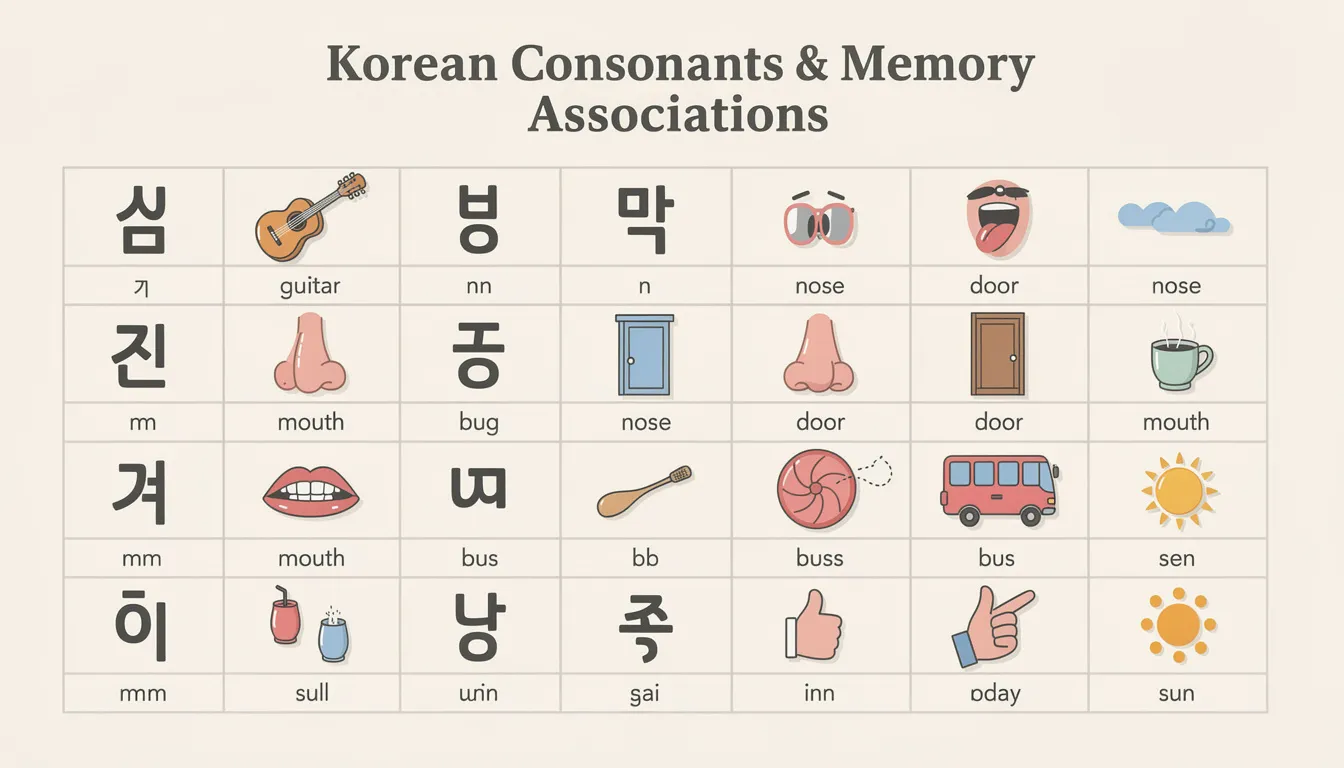
Basic Consonants: ㄱ, ㄴ, ㄷ, ㄹ, ㅁ, ㅂ, ㅅ, ㅇ, ㅈ
The nine basic consonants form the core of the korean alphabet and appear in the majority of common korean words. Each hangul consonant has a distinct sound and shape that korean language learners must memorize:
ㄱ (giyeok) - Pronounced like ‘g’ in “go” or ‘k’ in “ski” depending on position. The shape resembles a gun or the letter ‘L’ rotated.
ㄴ (nieun) - Sounds like ‘n’ in “nose.” The shape looks like a nose in profile or the letter ‘L’. For those interested in learning the basic sounds and pronunciation of Mandarin Chinese, check out this HSK Pronunciation Guide – Verbacard.
ㄷ (digeut) - Pronounced like ‘d’ in “door” or ‘t’ in “stop” based on position. Resembles a door frame or backwards ‘C’.
ㄹ (rieul) - A unique sound between ‘r’ and ‘l’ that doesn’t exist in English. The shape looks like a ladder or stairs.
ㅁ (mieum) - Sounds like ‘m’ in “mother.” The square shape resembles a mouth or window.
ㅂ (bieup) - Pronounced like ‘b’ in “ball” or ‘p’ in “spot” depending on context. Looks like a bed or table viewed from above.
ㅅ (siot) - Sounds like ‘s’ in “sun.” The pointed shape resembles a mountain peak or tooth.
ㅇ (ieung) - Silent when used as initial consonant, sounds like ‘ng’ in “song” as final consonant. The circle shape is easy to remember.
ㅈ (jieut) - Pronounced like ‘j’ in “jump” or ‘ch’ in “match” based on position. Resembles a hat or umbrella handle.
These basic consonants appear frequently in korean vocabulary and serve as the foundation for understanding more complex hangul sounds. Practice writing korean using these basic letters helps develop muscle memory and recognition skills essential for reading korean fluently.
Aspirated Consonants: ㅊ, ㅋ, ㅌ, ㅍ, ㅎ
Korean aspirated consonants are a group of Korean letters that produce a strong puff of air when pronounced, distinguishing them from their basic counterparts. These Korean alphabet letters represent sounds that require more forceful articulation and are called aspirated consonants because of the breath that accompanies their pronunciation.
ㅊ (chieut) - Sounds like ‘ch’ in “church” with a strong air puff. Related to basic consonant ㅈ but with aspiration.
ㅋ (kieuk) - Pronounced like ‘k’ in “kite” with emphasis. The aspirated version of basic consonant ㄱ.
ㅌ (tieut) - Sounds like ‘t’ in “top” with force. The aspirated counterpart to basic consonant ㄷ.
ㅍ (pieup) - Pronounced like ‘p’ in “pot” with strong air release. The aspirated version of basic consonant ㅂ.
ㅎ (hieut) - Sounds like ‘h’ in “house.” The shape resembles a person or the number 4.
To distinguish between basic and aspirated consonants, place your hand in front of your mouth when practicing Korean pronunciation. Korean aspirated consonants should produce a noticeable puff of air, while basic consonants should not. This physical awareness helps Korean language learners develop accurate Korean sounds and speak Korean more naturally.
Understanding the relationship between basic and aspirated consonants accelerates Korean learning. Each aspirated consonant corresponds to a basic consonant with added aspiration, making the pattern systematic rather than arbitrary. This logical structure reflects the scientific design principles that King Sejong incorporated into the Korean writing system.
Double Consonants: ㄲ, ㄸ, ㅃ, ㅆ, ㅉ
Double consonants represent the most challenging category for korean language learners, as they require tense pronunciation that doesn’t exist in English. These hangul consonants are formed by doubling five of the basic consonants, creating sounds that native korean speakers produce with tighter throat and lip muscles.
ㄲ (ssang giyeok) - A tense version of ㄱ that sounds like a sharp ‘k’ with restricted airflow.
ㄸ (ssang digeut) - The tense counterpart to ㄷ, pronounced as a tight ‘t’ sound.
ㅃ (ssang bieup) - A tense version of ㅂ that creates a sharp ‘p’ sound with muscle tension. If you're interested in learning other Asian scripts, you might find these effective strategies for memorizing the Thai alphabet helpful as well.
ㅆ (ssang siot) - The doubled version of ㅅ, producing an intense ‘s’ sound.
ㅉ (ssang jieut) - A tense version of ㅈ that sounds like a sharp ‘j’ or ‘ch’. (For a similar comparison in another language, see the Thai Pronunciation Guide.)
Only five double consonants exist in the korean alphabet, making them a manageable challenge for korean learning. The key to mastering these korean sounds lies in understanding that they’re not louder versions of basic consonants, but rather more tense versions produced with constricted vocal muscles. Practice with native korean speakers or quality audio resources is essential for developing accurate pronunciation of these challenging hangul letters.
Korean Vowels: Mastering the Sounds
The korean vowel system consists of 10 basic vowels that combine to form 11 additional complex vowel combinations, creating the foundation for korean syllable pronunciation. Unlike English vowels that can have multiple pronunciations, hangul vowels maintain consistent sounds, making korean alphabet pronunciation more predictable for korean language learners.
Korean vowels chart organization follows logical patterns based on positioning within korean syllable blocks. Vertical vowels (ㅏ, ㅑ, ㅓ, ㅕ, ㅣ) are positioned to the right of the initial consonant, while horizontal vowels (ㅗ, ㅛ, ㅜ, ㅠ, ㅡ) are positioned below the consonant. This systematic arrangement helps learners predict how to form syllable blocks when writing korean.
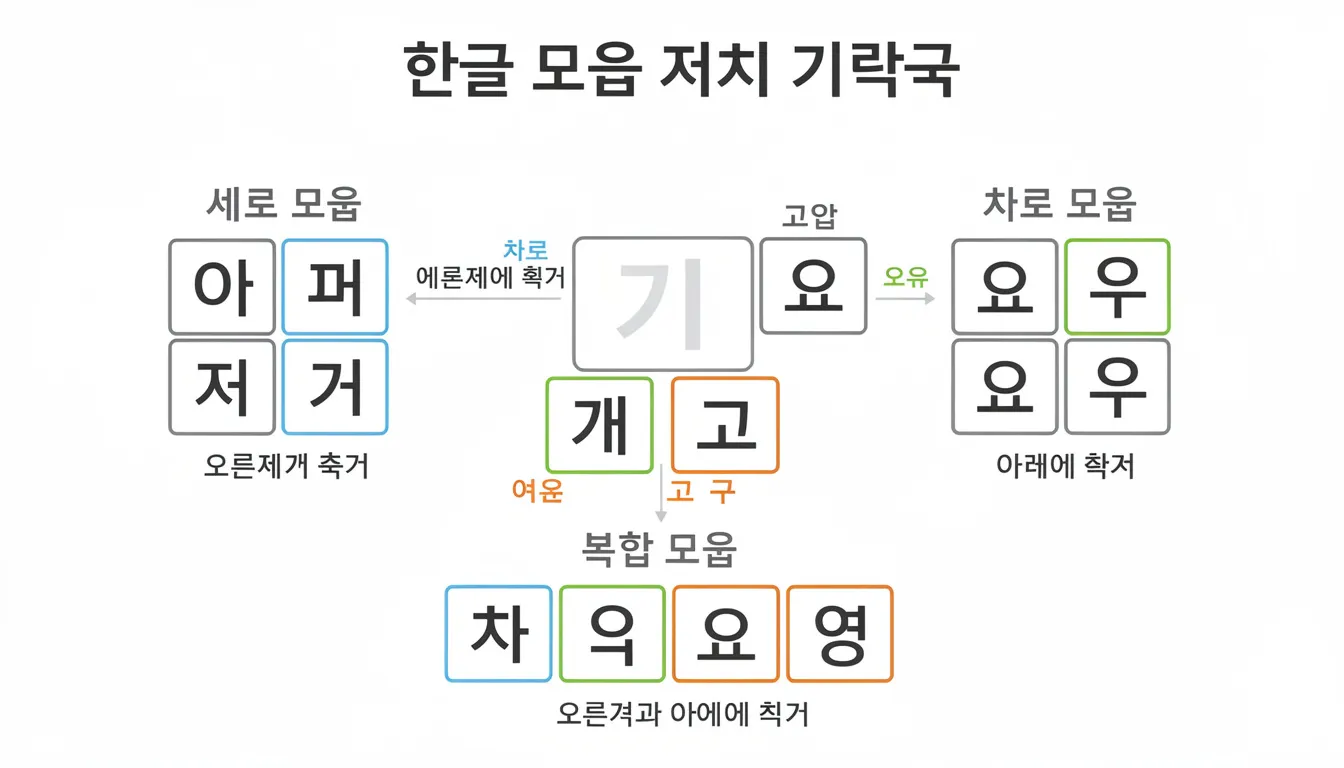
A helpful memory technique for basic korean vowels uses the phrase “Old Father, New Son” to remember the four cardinal vowels: ㅗ (oh), ㅏ (ah), ㅜ (oo), ㅓ (uh). These hangul basic vowels serve as the foundation for understanding all other korean vowel sounds and their relationships.
Basic Vowels: ㅏ, ㅑ, ㅓ, ㅕ, ㅗ, ㅛ, ㅜ, ㅠ, ㅡ, ㅣ
The 10 basic korean vowels form the core of korean pronunciation and appear in virtually all common korean words. Each hangul vowel maintains consistent pronunciation regardless of context, unlike English where vowel sounds frequently change:
ㅏ (a) - Sounds like ‘a’ in “father.” The horizontal line with vertical stroke resembles a person standing.
ㅑ (ya) - Pronounced “ya” like “yard.” Adding an extra stroke to ㅏ creates the ‘y’ sound prefix.
ㅓ (eo) - Sounds like ‘u’ in “bus” or ‘o’ in “love.” The stroke faces the opposite direction from ㅏ.
ㅕ (yeo) - Pronounced “yu” similar to “young.” The ‘y’ sound version of ㅓ with additional stroke.
ㅗ (o) - Sounds like ‘o’ in “boat.” The horizontal line with upward stroke suggests the ‘o’ sound.
ㅛ (yo) - Pronounced “yo” like “yoga.” The ‘y’ sound version of ㅗ with extra stroke.
ㅜ (u) - Sounds like ‘oo’ in “boot.” The downward stroke from horizontal line indicates the ‘u’ sound.
ㅠ (yu) - Pronounced “yu” like “you.” The ‘y’ sound version of ㅜ with additional stroke.
ㅡ (eu) - A unique korean sound like ‘u’ in “put” but with lips unrounded. The horizontal line resembles a brook.
ㅣ (i) - Sounds like ‘ee’ in “tree.” The vertical line looks like a tree trunk or the number 1.
Memory associations help cement these hangul vowels in long-term memory. The vowel ㅣ looks like a tree, ㅡ resembles a brook flowing horizontally, and the directional strokes in ㅏ and ㅓ can be remembered as pointing toward different directions. Regular practice writing korean using these basic vowels develops the muscle memory essential for korean writing fluency.
Complex Vowel Combinations
Beyond the 10 basic vowels, the korean alphabet includes 11 complex vowel combinations formed by blending basic vowels together. These compound vowels create additional sounds needed for complete korean pronunciation coverage, though some share pronunciation despite different spellings.
The complex vowel combinations include: ㅐ (ae), ㅒ (yae), ㅔ (e), ㅖ (ye), ㅘ (wa), ㅙ (wae), ㅚ (oe), ㅝ (wo), ㅞ (we), ㅟ (wi), ㅢ (ui)
These hangul vowels are formed through logical combinations:
-
ㅐ combines ㅏ + ㅣ to create “ae” sound like “cat”
-
ㅔ combines ㅓ + ㅣ to create “e” sound like “bed”
-
ㅘ combines ㅗ + ㅏ to create “wa” sound like “water”
-
ㅝ combines ㅜ + ㅓ to create “wo” sound like “won”
For korean language learners beginning their korean learning journey, focusing on mastering basic vowels first provides a solid foundation before tackling these combinations. Many complex vowel combinations appear less frequently in common korean vocabulary, making basic vowels the priority for initial korean alphabet chart study.
Modern korean pronunciation has simplified some distinctions between complex vowels. For example, ㅐ (ae) and ㅔ (e) are often pronounced identically by younger native korean speakers, though they remain distinct in writing. This evolution reflects how spoken language naturally changes over time while the korean writing system preserves historical distinctions.
How Korean Syllables Work
Understanding korean syllable blocks is crucial for anyone learning korean letters, as these blocks form the fundamental structure of the korean writing system. Every korean syllable follows specific construction rules that determine how consonants and vowels combine within invisible square boundaries to create readable korean characters.
A korean syllable block must contain a minimum of one consonant and one vowel, but can accommodate up to four letters maximum. The structure follows a predictable pattern: initial consonant (required), vowel (required), and optional final consonant called 받침 (batchim). This systematic approach makes writing korean more organized than linear alphabetic systems.
Vowel placement rules determine the overall structure of each syllable block:
-
Vertical vowels (ㅏ, ㅑ, ㅓ, ㅕ, ㅣ) position to the right of the initial consonant
-
Horizontal vowels (ㅗ, ㅛ, ㅜ, ㅠ, ㅡ) position below the initial consonant
-
Complex vowels follow the dominant vowel’s positioning rule
For more guidance and tips on mastering language scripts, check out our comprehensive articles.
When a syllable includes a final consonant (batchim), it always appears at the bottom of the syllable block, regardless of the vowel type. This creates a stable foundation for each korean syllable and maintains visual balance within the square formation.
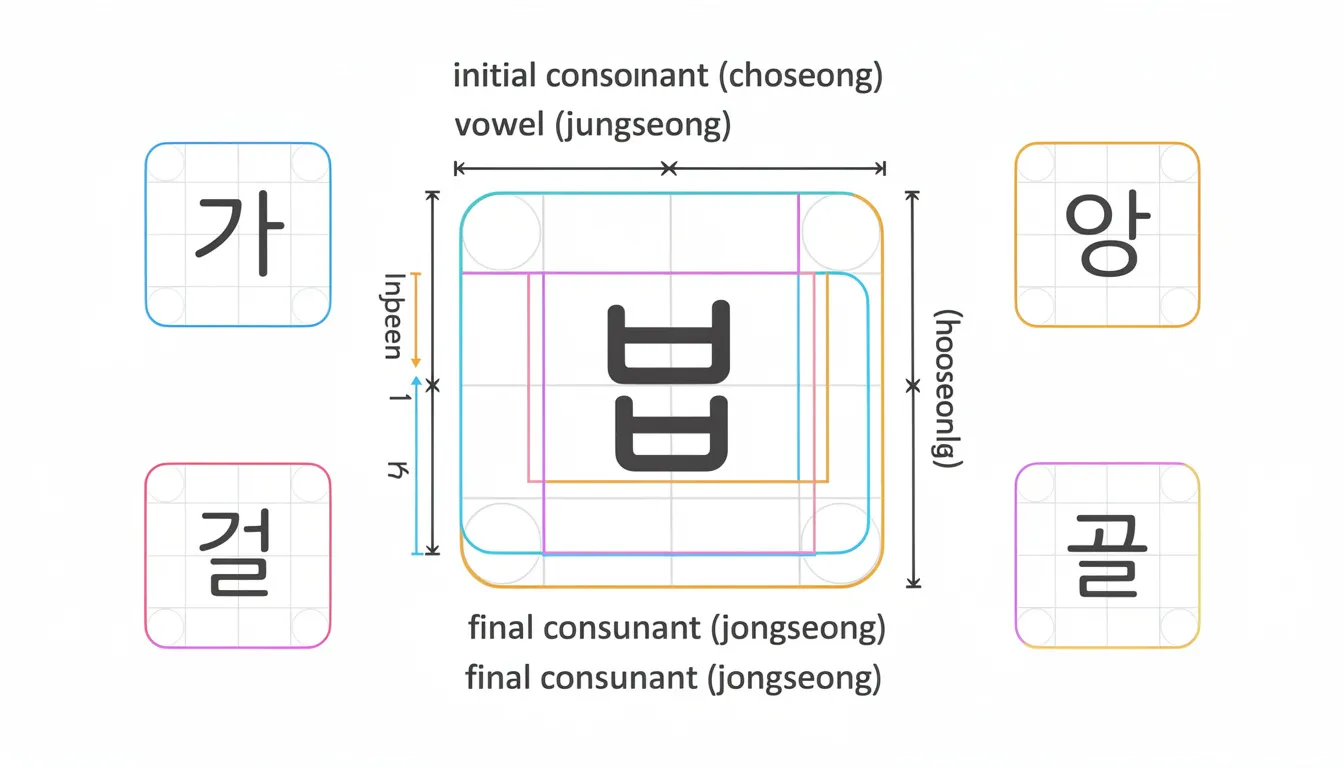
The genius of this system becomes apparent when reading korean texts. Each syllable block represents one complete syllable in the korean language, making it easy to identify syllable boundaries and maintain proper korean pronunciation rhythm. Unlike English where syllable divisions can be ambiguous, korean syllable blocks provide clear visual separation that aids both reading and pronunciation development for korean language learners.
Reading Korean Words: Step-by-Step Practice
Developing the ability to read korean requires systematic practice progressing from simple two-letter syllables to complex multi-syllable korean words. The ability to read hangul is the foundational step for mastering Korean reading skills. The key is building confidence with basic patterns before advancing to more challenging korean vocabulary and korean texts.
Start with fundamental two-letter combinations using basic consonants and vowels:
-
가 (ga) - ㄱ + ㅏ
-
나 (na) - ㄴ + ㅏ
-
다 (da) - ㄷ + ㅏ
-
바 (ba) - ㅂ + ㅏ
-
사 (sa) - ㅅ + ㅏ
These simple korean syllables form the foundation for reading korean and help learners understand how hangul consonants and hangul vowels combine systematically. Practice pronouncing each syllable clearly while visualizing the letter combinations within their syllable blocks.
Progress to common korean words that appear frequently in everyday conversation:
|
Korean Word |
Romanization |
English Meaning |
|---|---|---|
|
안녕하세요 |
annyeonghaseyo |
Hello (formal) |
|
감사합니다 |
gamsahamnida |
Thank you |
|
죄송합니다 |
joesonghamnida |
Sorry |
|
안녕히 가세요 |
annyeonghi gaseyo |
Goodbye |
|
네 |
ne |
Yes |
|
아니오 |
anio |
No |
|
물 |
mul |
Water |
|
밥 |
bap |
Rice/food |
|
집 |
jip |
House |
|
학교 |
hakgyo |
School |
When reading korean, follow the natural direction: left to right across syllable blocks, top to bottom within each block. This reading pattern helps maintain proper korean pronunciation rhythm and develops the visual scanning skills necessary for fluent korean reading.
Practice with these beginner-friendly korean words builds confidence and demonstrates how the systematic nature of hangul letters enables progressive korean learning. Each word reinforces the connection between written hangul characters and spoken korean sounds, strengthening both reading and pronunciation skills simultaneously.
Writing Korean Letters: Stroke Order and Technique
Proper stroke order forms the foundation of efficient hangul writing and significantly impacts both writing speed and character legibility. The korean writing system follows consistent stroke order principles that, once mastered, make writing korean letters natural and fluid for korean language learners.
The fundamental rule for hangul stroke order is always beginning from the top-left corner of each character. This principle applies to both korean consonants and hangul vowels, creating a systematic approach that works across all korean alphabet letters. Unlike Chinese characters that can have dozens of strokes, hangul letters contain a maximum of only five strokes each, making the korean writing system remarkably efficient.
Basic stroke order patterns for korean letters:
-
Horizontal lines are drawn from left to right
-
Vertical lines are drawn from top to bottom
-
When horizontal and vertical lines intersect, horizontal lines come first
-
Enclosed areas are completed before adding final strokes
-
Additional decorative strokes are added last
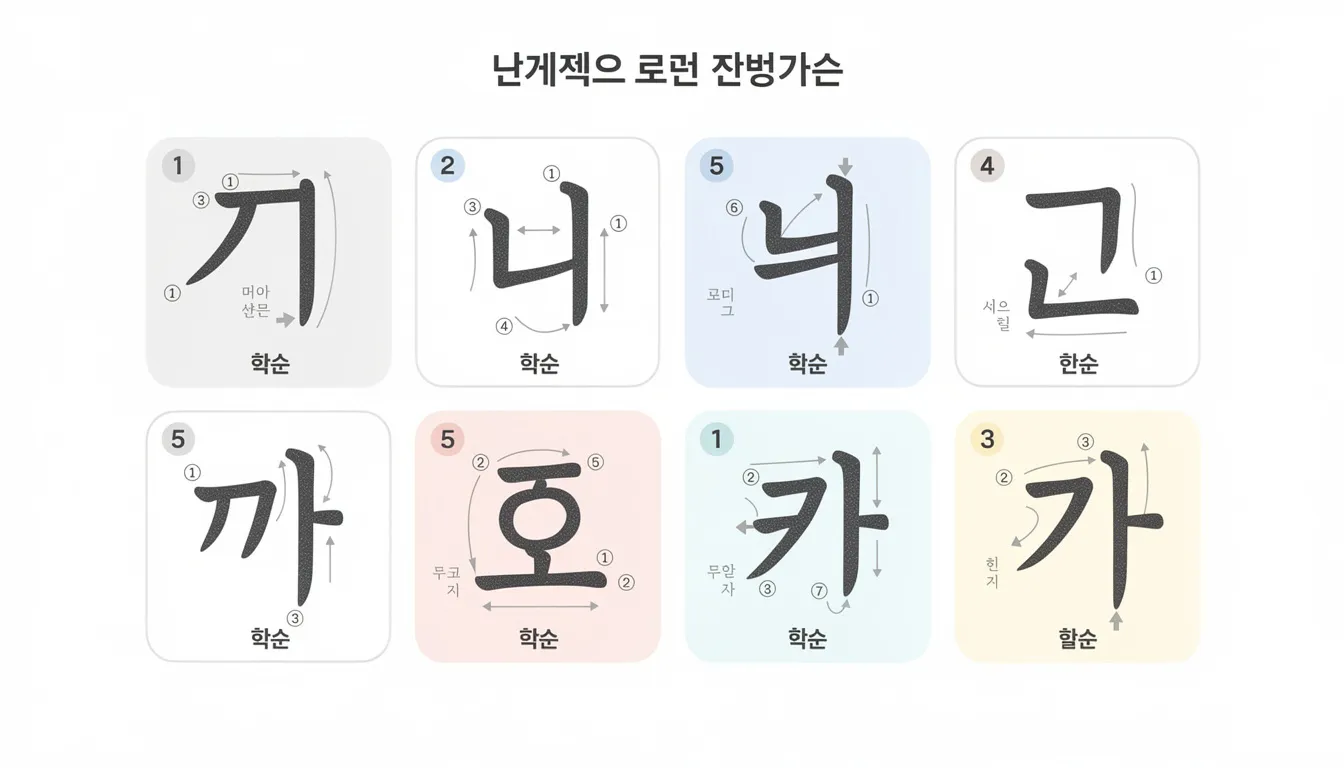
For example, when writing ㄱ (giyeok), start with the horizontal line from left to right, then add the vertical line from top to bottom. When writing ㅂ (bieup), draw the outer frame first, then add the internal horizontal line. This systematic approach applies to all hangul letters and becomes automatic with practice.
Regular practice writing korean using proper stroke order develops muscle memory that accelerates writing speed and improves character recognition. Korean language learners who invest time in correct stroke order from the beginning avoid developing bad habits that are difficult to correct later. Dedicate 15-20 minutes daily to practice writing each korean alphabet letter following proper stroke sequences.
Consider writing your name in korean as an engaging practice exercise. Using romanized hangul conversion guides, identify the hangul characters that best represent the sounds in your name, then practice writing these characters repeatedly using correct stroke order. This personal connection makes practice more meaningful and helps cement stroke patterns in memory.
Learning Tips and Strategies
Successful korean learning requires consistent practice, strategic resource selection, and effective study techniques tailored to the unique characteristics of the korean alphabet. The following proven strategies help korean language learners achieve faster progress and better retention when mastering hangul characters.
Establish a Daily Practice Routine: Dedicate 30 minutes daily to korean alphabet practice rather than longer, infrequent sessions. Consistent exposure helps transfer hangul letters from short-term to long-term memory more effectively. Break practice sessions into focused segments: 10 minutes for consonant review, 10 minutes for vowel practice, and 10 minutes for reading korean words.
Use Spaced Repetition Systems: Use flashcards for all korean alphabet letters and review them using spaced repetition principles. Flashcards can automate this process, showing challenging hangul characters more frequently while spacing out well-known letters. This technique optimizes memory consolidation and reduces total study time needed.
Practice with Audio Resources: Korean pronunciation differs significantly from english alphabet sounds, making audio practice essential. Use korean alphabet charts with native speaker recordings to develop accurate korean sounds from the beginning. Listen to each hangul letter pronunciation multiple times and practice speaking aloud to develop proper korean pronunciation habits.
Immerse Yourself in Korean Content: Watch Korean dramas, listen to Korean music, or follow Korean social media accounts with dual subtitles (Korean and English). This exposure helps you see hangul in natural contexts and reinforces the connection between written korean characters and spoken korean. Start with content slightly below your current level to maintain comprehension while building recognition speed.
Join Korean Learning Communities: Connect with other korean language learners through online forums, local language exchange groups, or social media communities focused on korean culture. In addition, take advantage of online resources such as websites, apps, and interactive platforms to enhance your Hangul and Korean learning. Sharing challenges, celebrating progress, and receiving encouragement accelerates motivation and provides practical learning tips from experienced learners.
Use Multiple Learning Modalities: Combine visual, auditory, and kinesthetic learning approaches. Write hangul letters while saying them aloud, use colorful korean alphabet charts, and practice forming syllable blocks with your hands in the air. This multi-sensory approach strengthens neural pathways and improves retention.
Common Mistakes to Avoid
Korean language learners often encounter predictable challenges when learning the korean alphabet, but understanding these common pitfalls helps prevent frustration and accelerates progress toward reading korean fluently.
Over-reliance on Romanized Hangul: While romanization helps initially, dependence on romanized korean prevents developing true hangul reading skills. Romanization cannot accurately represent all korean sounds and creates pronunciation habits that interfere with authentic korean pronunciation. Transition away from romanization as quickly as possible and focus on reading actual hangul characters.
Ignoring Sound Change Rules: Korean pronunciation involves complex sound changes where hangul consonants modify based on their position within korean syllables or when adjacent to other sounds. For example, ㄱ sounds like ‘g’ at the beginning of words but like ‘k’ at the end. Learning these patterns is essential for accurate korean pronunciation and natural-sounding speech.
Neglecting Stroke Order Practice: Skipping proper stroke order may seem unimportant initially, but incorrect stroke patterns slow writing speed and affect character recognition. Korean letters written with proper stroke order look more natural and are easier to write quickly. Invest time in correct stroke order from the beginning to avoid developing persistent bad habits.
Rushing Through Basic Letters: The temptation to quickly memorize all korean alphabet letters without thorough practice leads to weak foundations. Master basic consonants and basic vowels completely before advancing to aspirated consonants, double consonants, or complex vowel combinations. Solid fundamentals enable faster progress with advanced korean learning topics.
Studying in Isolation: Learning hangul letters as isolated symbols without practicing them in korean words limits practical application. Always practice new letters within actual korean vocabulary to understand how they function in real korean texts. This contextual learning improves both recognition and retention.
Comparing to English Too Directly: Korean sounds don’t always have exact English equivalents, and forcing Korean pronunciation into English sound categories creates inaccurate pronunciation. Accept that some korean vowels and korean consonants require developing new mouth positions and sounds not found in the english alphabet.
Inconsistent Practice Schedules: Sporadic study sessions are less effective than consistent daily practice for language learning. Your brain needs regular exposure to hangul patterns to develop automatic recognition. Even 15 minutes of daily korean alphabet practice produces better results than hour-long weekly sessions.
Neglecting Speaking Skills: After learning the Korean alphabet, it's important to focus on developing speaking skills. Practice pronunciation and spoken language regularly to build confidence and become proficient in Korean conversation.
Resources for Korean Language Learners
Embarking on your Korean learning journey is easier than ever, thanks to a wealth of resources designed to help you master the Korean alphabet and develop your language skills. Whether you prefer self-study or structured courses, there are tools to suit every learning style and goal.
Online platforms like Duolingo, Rosetta Stone, and Talk To Me In Korean offer interactive lessons that cover everything from Hangul characters and Korean pronunciation to essential Korean words and grammar. These resources often include practice exercises, quizzes, and audio recordings by native speakers, making it easy to reinforce your understanding of Korean consonants, vowels, and the overall writing system.
For those who enjoy a more traditional approach, textbooks and workbooks provide comprehensive guides to writing Korean, including stroke order, Korean double consonants, and common Korean words. Many universities and language schools also offer Korean language courses, both in-person and online, giving you access to expert instruction and peer support.
Language exchange programs and online communities are invaluable for Korean language learners seeking real-world practice. Engaging with native speakers helps you refine your Korean pronunciation, expand your vocabulary, and gain insights into Korean culture. Participating in forums or social media groups dedicated to Korean learning can also keep you motivated and connected.
As you progress, it’s important to explore the cultural aspects of the language, such as the influence of Chinese characters on Korean vocabulary and the role of double consonants in Korean writing. Mastering Hangul is the foundation, but immersing yourself in Korean culture and everyday language use will truly enhance your Korean skills and make your learning experience more rewarding.
With consistent practice, the right resources, and a genuine interest in Korean culture, you’ll find yourself reading, writing, and speaking Korean with increasing confidence. Remember, every step you take brings you closer to understanding not just the Korean alphabet, but the heart of Korean language and culture itself.
Next Steps After Learning Hangul
Mastering hangul characters opens the door to deeper korean language exploration, but knowing where to direct your korean learning journey next ensures continued progress toward fluency. The transition from korean alphabet recognition to practical korean language skills requires strategic planning and realistic goal-setting.
Build Essential Korean Vocabulary: Start with high-frequency korean words that appear in everyday conversation. Focus on common korean words related to greetings, family, food, colors, numbers, and basic actions. Learning 100-200 essential korean words provides the foundation for simple korean conversation and reading basic korean texts. Use these words to practice reading korean in context while reinforcing hangul character recognition.
Study Basic Korean Grammar Patterns: While hangul gives you the ability to read korean, understanding korean grammar transforms reading into comprehension. Begin with fundamental sentence structures, basic verb conjugations, and essential particles that show relationships between words. Korean grammar differs significantly from English, but systematic study makes these patterns manageable.
Practice Reading Authentic Korean Materials: Progress from practice exercises to real korean texts like simple news articles, children’s books, social media posts, or restaurant menus. Start with materials that include familiar vocabulary and gradually challenge yourself with more complex content. Reading authentic materials exposes you to natural korean writing styles and cultural contexts.
Develop Korean Conversation Skills: Use language learning apps with speaking practice, find korean language exchange partners, or join conversation groups to practice speak korean. The connection between reading hangul and producing korean sounds strengthens through regular speaking practice. Don’t worry about perfection—consistent practice builds confidence and fluency over time.
Explore Korean Culture Through Language: Engage with korean culture through Korean dramas, music, films, and cultural content that interests you. Understanding cultural context makes korean learning more meaningful and provides natural motivation to continue advancing your korean skills. Cultural immersion also exposes you to diverse korean vocabulary and expressions.
Consider Structured Korean Courses: While self-study can take you far, structured korean language courses provide systematic progression, professional guidance, and peer interaction. Look for courses that build on your hangul foundation and address your specific goals, whether conversational fluency, academic korean, or business korean skills.
Your korean learning journey from mastering hangul to korean language proficiency requires patience, consistency, and strategic progression. Set realistic milestones, celebrate achievements along the way, and remember that every expert korean speaker started exactly where you are now—learning their first hangul letter. The systematic nature of the korean alphabet that made initial learning possible will continue supporting your advancement through every stage of korean language development.
With dedication and proper guidance, the 24 hangul letters you’ve learned will unlock access to korean literature, media, conversation, and cultural understanding. Your investment in learning the korean alphabet provides the foundation for a lifelong connection to korean language and korean culture, opening opportunities for personal growth, professional development, and meaningful cross-cultural relationships.