

For nearly eight centuries, the thai script has remained remarkably unchanged since its establishment in 1283. This stability means that mastering writing thai letters today connects you directly with centuries of literary tradition. Unlike many modern languages that have evolved significantly, the thai alphabet you learn to write is essentially the same system used by thai speakers throughout history. The thai script has a khmer origin, having been historically derived from Khmer and related South Asian scripts, which influenced its structure and development.
The thai language uses an abugida writing system with 44 consonant symbols and 16 standard vowel symbols, plus vowel diphthongs. While this might seem daunting initially, the systematic nature of thai script makes it entirely learnable with proper technique and consistent practice. The main difference between the thai script and other writing systems is its tonal nature, the absence of spaces between words, and its unique structure compared to alphabets and syllabaries. This comprehensive guide will take you through every aspect of writing thai letters, from basic stroke formation to developing professional-looking handwriting.
Whether you’re a complete beginner or looking to refine your technique, understanding the fundamental principles of thai writing will accelerate your progress and help you avoid common mistakes that can hinder your development. To read thai effectively, you need to grasp not only the script but also its tones and structural rules, which can be challenging for new learners.
Introduction to the Thai Language
The Thai language, often referred to as Siamese, is the official language of Thailand and is spoken by around 60 million people worldwide. As a member of the Tai-Kadai language family, Thai is unique for its use of tones—each word can have different meanings depending on the tone used. There are five distinct tones in the Thai language: low, mid, high, falling, and rising. This tonal nature means that mastering pronunciation is just as important as learning the Thai alphabet itself. For anyone looking to communicate effectively with Thai speakers or to read and write Thai, understanding these tones and how they interact with each word is essential. The structure of the Thai language, with its tonal system and rich vocabulary, provides a fascinating foundation for anyone eager to learn Thai and connect with its speakers.
Understanding the Thai Alphabet
The Thai alphabet, or Thai script, is a sophisticated writing system that sets the Thai language apart from many others. It is classified as an abugida, meaning that each consonant carries an inherent vowel sound unless otherwise marked. The Thai script consists of 44 consonant symbols and 15 primary vowel symbols, with additional vowel combinations to represent all the sounds of the language. Originating from the Old Khmer script, the Thai alphabet reflects its historical roots while serving the needs of modern Thai. When you write Thai, you’ll notice that vowels can appear above, below, in front of, or behind the consonant they modify, and tone marks are used to indicate the tone of each word. This combination of consonants, vowel symbols, and tone marks forms the backbone of the Thai writing system. The Thai script is also used for writing Pali and Sanskrit, especially in religious and historical contexts, making it a versatile tool for expressing a wide range of ideas and traditions. Understanding how the Thai alphabet works is the first step toward reading, writing, and appreciating the depth of the Thai language.
Essential Thai Letter Writing Basics
Thai script contains 44 consonants and 32 vowels written in specific stroke orders from left to right, top to bottom. This systematic approach ensures that every thai word maintains consistent appearance and readability. The thai writing system differs significantly from the english language in that letters are written without spaces between words, using continuous connected script similar to cursive writing.
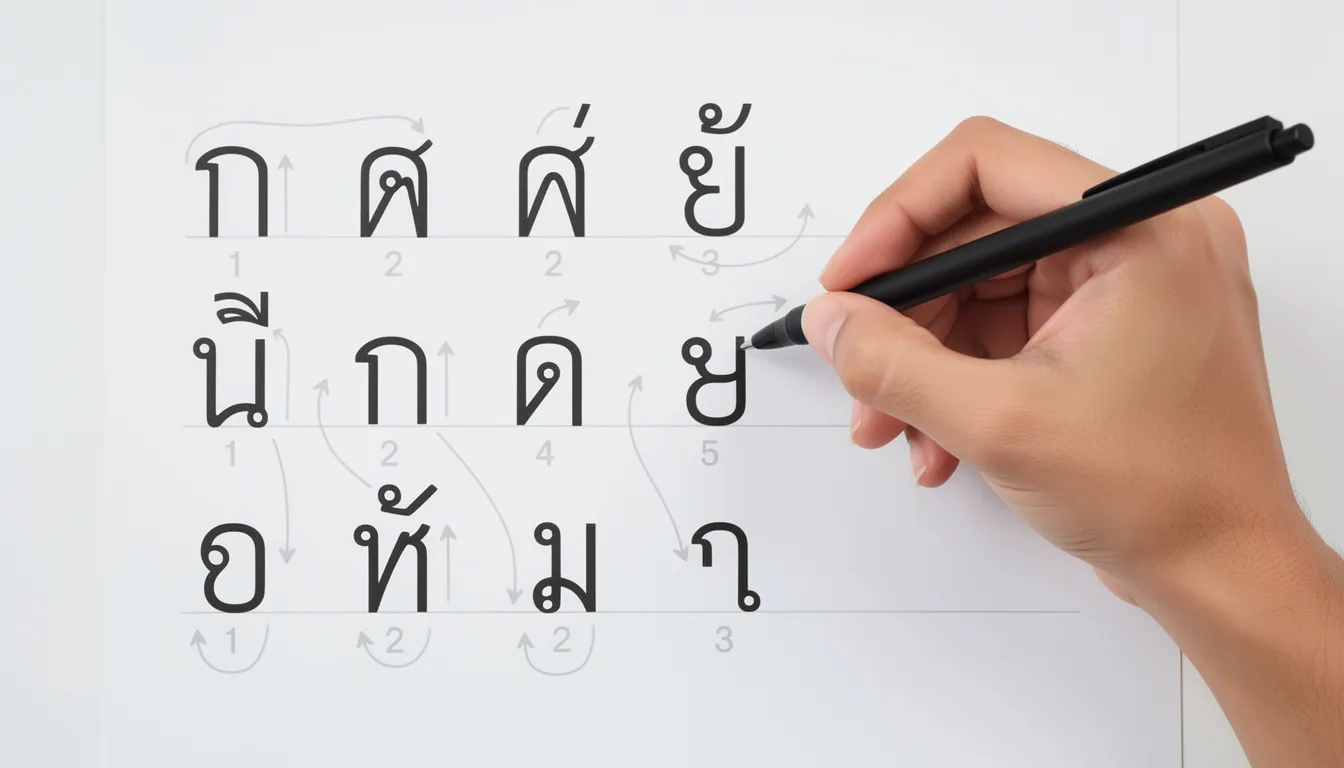
Each thai letter has a specific stroke sequence that must be followed for proper formation and legibility. Unlike capital letters in english speakers’ writing systems, thai letters maintain uniform height within their classification, with variations only for specific letter types that extend above or below the baseline.
Essential writing tools for beginners:
-
Fine-tip pen or pencil (0.5mm recommended)
-
Lined practice paper with 1cm spacing
-
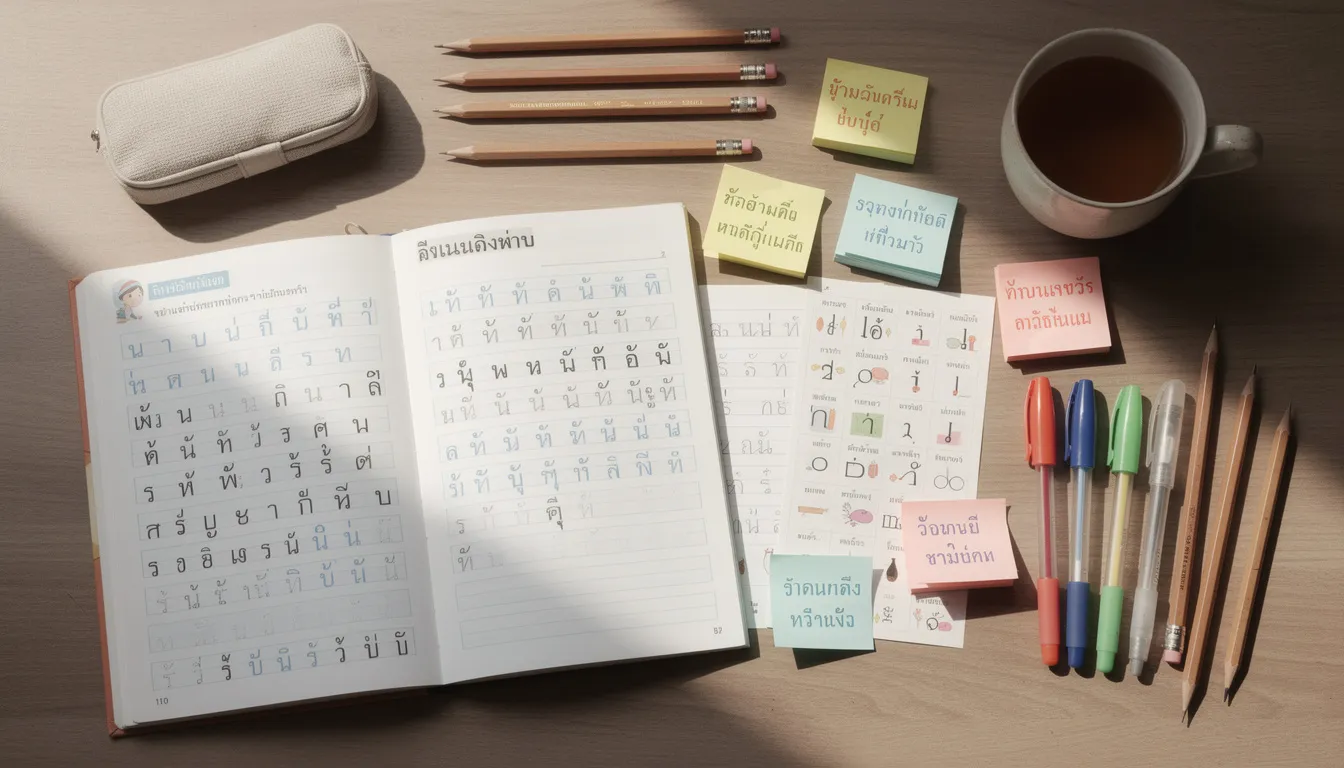
Thai-specific practice notebooks when available
-
Good lighting and comfortable writing position
The thai alphabet functions as a tonal language system where tone marks combine with consonants to create the distinctive thai tones. Understanding this foundation helps explain why precise letter formation matters so much in thai writing - small variations can change meaning entirely.
Thai Consonant Letter Formation
Start with basic consonants like ก (kor gai), ข (khor khai), ค (khor khwai) - practice stroke order diagrams until the movements become automatic. These fundamental letters form the backbone of thai text and appear frequently in native thai words. Historically, ฃ (kho khuat) was also used as a basic consonant, but it is now considered obsolete and is no longer standard in modern writing. Kho khuat was omitted from early typewriters due to space constraints, though it still appears on some keyboards and in certain character sets.
Most thai consonants begin with a clockwise circular motion or vertical downstroke. This consistent starting approach helps develop muscle memory and ensures your handwriting maintains the flowing characteristic of proper thai script. The initial consonant in any syllable sets the foundation for the entire letter combination.
Letter heights and positioning:
-
Standard consonants sit on the baseline (ก, ด, ต, น, ม)
-
Some extend above the baseline (ป, ฟ, ฝ, ภ)
-
Others extend below (ญ, ฎ, ฏ)
-
Maintain consistent proportions within each category
Practice writing consonants in groups of similar shapes to develop pattern recognition. Round letters (ด, ต, บ, ป) share similar circular motions, while angular letters (ก, ข, ค) use more linear strokes. Write each consonant 20-30 times daily, focusing on consistent size and spacing rather than speed.
The three classes of consonants - high class consonants, middle class consonants, and low class consonants - each have their own set of tone rules. Among these, two consonants—ฃ (kho khuat) and ฅ (kho khon)—are now obsolete or rarely used, but they were originally part of the Thai consonant system. While this classification primarily affects pronunciation and tone marker usage, understanding it helps with proper letter formation and spacing in thai text.
Consonant Classes: High, Middle, and Low
A unique feature of the Thai alphabet is its division of consonants into three classes: high, middle, and low. This classification is not just for organization—it directly influences the tone of each syllable in the Thai language. High class consonants, such as ข (kho khai), often produce a high tone when combined with certain tone marks, while middle class consonants, like ก (ko kai), typically result in a mid tone. Low class consonants, such as ค (kho khon), are associated with low tones. The class of a consonant determines how tone rules are applied, which is crucial for correct pronunciation and meaning. For example, the same pronunciation may be represented by different consonants from different classes, affecting the tone of the word. Mastering the three classes—high class consonants, middle class consonants, and low class consonants—is essential for anyone who wants to write Thai accurately and understand the tonal structure of the language. Recognizing the class of each consonant, such as distinguishing between kho khai (high class) and kho khon (low class), will help you apply the correct tone rules and write Thai words with confidence.
Writing Thai Vowel Symbols
Short vowels like อะ, อิ, อุ require quick, precise strokes above or around the base consonant. These vowel symbols must be positioned correctly relative to their preceding consonant to maintain readability. The inherent vowel sound in thai script means that consonants carry an implied vowel when no explicit vowel symbol appears.
Long vowel symbols like อา, อี, อู use extended strokes - practice maintaining consistent vowel length visually to distinguish them clearly from their short vowel counterparts. The difference between short sound and long vowel pronunciation often determines word meaning, making precise formation crucial.
Complex vowels like เอือ, เอีย combine multiple components that must be written in specific sequence. Write each part separately first before attempting the complete combination. These combinations represent some of the most challenging aspects of thai writing but follow predictable patterns once mastered.
Vowel positioning rules:
-
Some appear before consonants (เ, แ, โ, ใ, ไ)
-
Others after consonants (ะ, า, ิ, ี, ึ, ื, ุ, ู)
-
Above consonants (ิ, ี, ึ, ื)
-
Below consonants (ุ, ู)
-
Some vowels can also appear in a medial position relative to the consonant, such as being placed above, below, in front of, or behind the consonant. Understanding these medial positions is key to mastering the abugida structure of Thai script.
Use the consonant อ as practice base for vowel combinations until comfortable with placement. This neutral consonant provides ideal practice for learning vowel sound positioning without worrying about complex consonant formation simultaneously.
Tone Mark Writing Technique
Four tone marks (่ ้ ๊ ๋) are written above the initial consonant or vowel symbol with precise positioning that affects the entire syllable’s pronunciation. These tone markers distinguish between falling tone, high tone, low tone, and rising tone in the tonal language system.
The tone marker ่ (mai ek) uses a short diagonal stroke from upper right to lower left. This mark appears most frequently and must be positioned directly above the target letter. Misplacement even by a few millimeters can obscure meaning or create confusion for readers.
Tone mark ้ (mai tho) forms a curved hook shape starting from the right side. This mark indicates a different tonal pattern and requires smooth, confident strokes to avoid appearing scratchy or unclear.
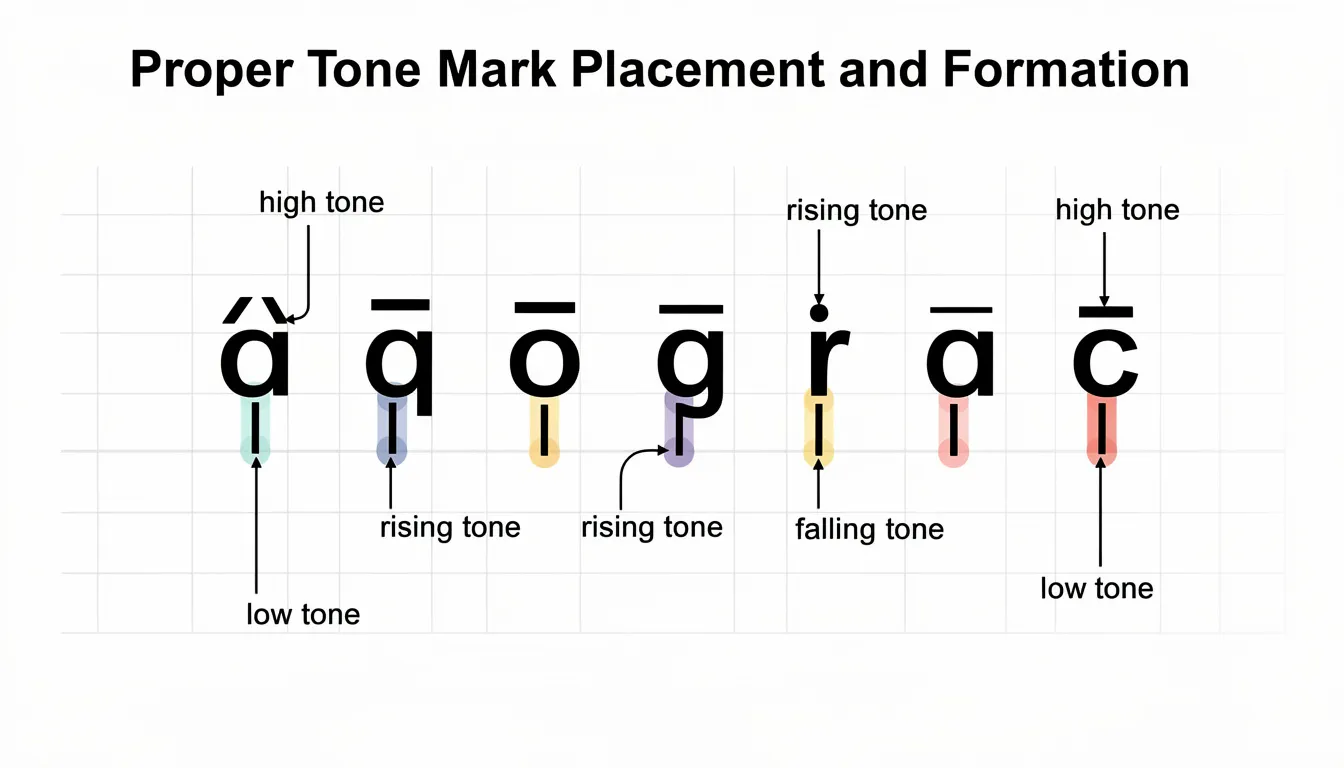
Tone marks ๊ and ๋ (mai tri, mai chattawa) appear less frequently, used mainly with middle class consonants in specific tonal contexts. While less common in everyday thai text, mastering these marks ensures complete competency in writing pali sanskrit loanwords and formal thai text.
Critical positioning guidelines:
-
Position tone marks precisely above the target letter
-
Maintain consistent height and spacing
-
Never place tone marks on final consonant positions
-
In open syllable configurations, place above the main consonant
-
For closed syllables, positioning depends on vowel placement
Stroke Order and Direction Rules
General rule: write from left to right, top to bottom within each letter. This systematic approach ensures that your hand movements flow naturally and produce consistent letter formation across all thai writing.
Circular components always start from the top and move clockwise. This rule applies to letters like ด, ต, ป, and similar rounded forms. Starting at any other position disrupts the natural flow and often produces awkward-looking results.
Vertical strokes write downward from top to bottom, while horizontal strokes move from left to right. Complex letters require completing the main body first, then adding dots, hooks, or extending parts in the final position.
Essential stroke sequence principles:
-
Complete the main consonant structure before vowels
-
Add vowel symbols in their designated positions
-
Place tone marks last, after all other elements
-
Maintain consistent pressure throughout each stroke
-
Lift pen only when necessary between distinct components
Practice with stroke-by-stroke guides available in standard thai textbooks. These diagrams show numbered sequences that help develop proper muscle memory for each letter formation.
Understanding stroke order becomes particularly important when writing quickly or in cursive-style thai text. Proper sequence allows for faster writing without sacrificing legibility or accuracy.
Letter Sizing and Proportions
Standard thai letter height measures approximately 5mm on ruled practice paper. This baseline measurement helps maintain consistency across different thai letters and creates professional-appearing text suitable for formal documents or correspondence.
Maintain consistent proportions where tall letters (ป, ฟ, ฝ) reach 1.5 times standard height. These ascending letters create visual rhythm in thai text and must maintain their distinctive appearance to preserve readability and aesthetic appeal.
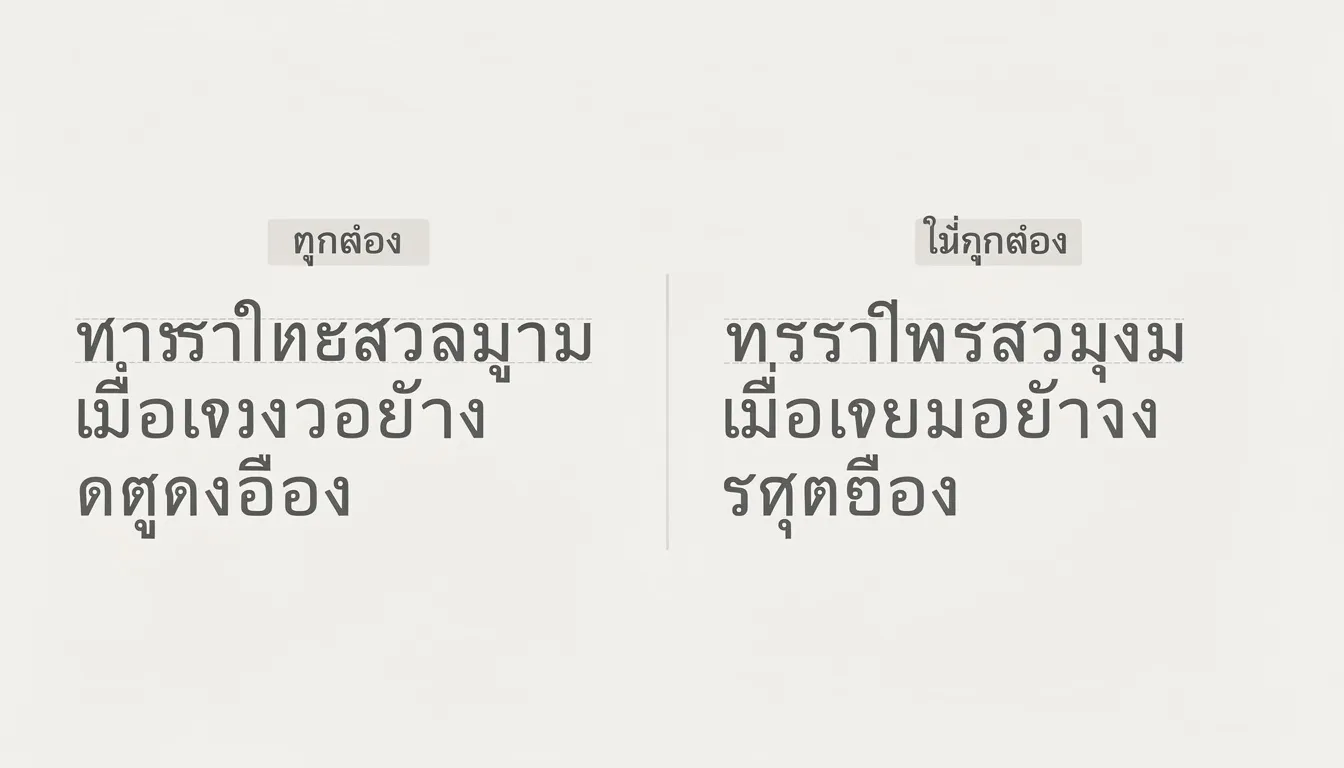
Letters with descenders (ญ, ฎ) extend 2-3mm below the baseline. These descending elements balance the visual weight of ascending letters and contribute to the overall harmony of thai script appearance.
Proportioning guidelines:
|
Letter Type |
Height Ratio |
Examples |
|---|---|---|
|
Standard |
1.0x (5mm) |
ก, ด, น, ม |
|
Ascending |
1.5x (7.5mm) |
ป, ฟ, ฝ, ภ |
|
Descending |
1.0x + 2-3mm below |
ญ, ฎ, ฏ |
Vowel symbols should maintain proportional relationships to their base consonant. Oversized or undersized vowels create visual imbalance and can affect reading comprehension for native thai speakers.
Use graph paper initially to maintain uniform letter spacing and alignment. The structured grid helps develop consistent spacing habits that transfer to regular paper once the proportions become automatic.
Writing Tools and Practice Materials
Recommended tools include 0.5mm mechanical pencils or fine-tip gel pens for precision work. These writing instruments provide the control needed for the detailed strokes required in thai script while maintaining consistent line weight throughout extended practice sessions.
Practice paper options vary from thai-specific lined notebooks available at Asian bookstores to standard ruled paper with appropriate spacing. Thai-designed practice books often include stroke order guides and spacing templates that accelerate learning.
Digital alternatives include tablets with stylus using applications like “Thai Writing Practice” or “Learn Thai Script.” These digital tools often provide immediate feedback and can demonstrate proper stroke sequences through animation.
Recommended practice materials:
-
Tracing sheets with downloadable thai letter templates
-
Graph paper for proportion practice
-
Light table or window for tracing exercises
-
Timer for structured practice sessions
-
Progress tracking sheets for motivation
Professional calligraphy pens can enhance the aesthetic appeal of advanced thai writing, though beginners should master basic formation before exploring decorative techniques.
Forming Syllables in Thai Script
In Thai script, forming a syllable is a process that brings together a consonant, a vowel, and sometimes a tone mark to create a complete sound unit. The consonant serves as the base, with the vowel symbol placed in a specific position—above, below, before, or after the consonant—depending on the vowel’s form. If the syllable requires a particular tone, a tone mark is added above the consonant or vowel. For example, the syllable “กา” (ka) is formed by combining the consonant ก (ko) with the vowel า (a). To indicate a falling tone, the tone mark “้” is added, changing the meaning and pronunciation of the word. This system allows the Thai language to represent a wide variety of sounds and meanings efficiently. Understanding how to combine these elements in Thai script is key to reading and writing Thai words correctly, as each component plays a vital role in conveying the intended meaning and tone.
Live and Dead Syllables
Syllables in the Thai language are categorized as either live or dead, a distinction that significantly affects pronunciation and meaning. A live syllable ends with a vowel sound or a sonorant consonant, resulting in a longer, more open sound. For example, “กา” (ka) is a live syllable because it ends with the vowel sound “a.” In contrast, a dead syllable ends with a stop consonant, such as “p,” “t,” or “k,” or with a short vowel, producing a shorter, clipped sound. An example is “กับ” (kap), where the final consonant “บ” (b) closes the syllable, making it dead. This difference between live syllable and dead syllable is crucial in the Thai language, as it influences both the vowel sound and the application of tone rules. Recognizing whether a syllable is live or dead will help you pronounce Thai words accurately and write them correctly in Thai script, ensuring clear communication and understanding.
Common Writing Mistakes to Avoid
Incorrect stroke direction leads to awkward letter formation and disrupts the natural flow of thai handwriting. Many learners attempt to write thai letters using english language stroke patterns, which produces visually unappealing results and slows writing speed.
Inconsistent letter spacing makes thai text difficult to read since the writing system relies on visual word boundaries rather than explicit spaces. Maintain uniform gaps between consonant clusters while keeping related elements properly connected.
Wrong vowel placement represents one of the most serious errors in thai writing since it can change word meaning entirely. Practice vowel positioning carefully, referring to established models until placement becomes automatic.
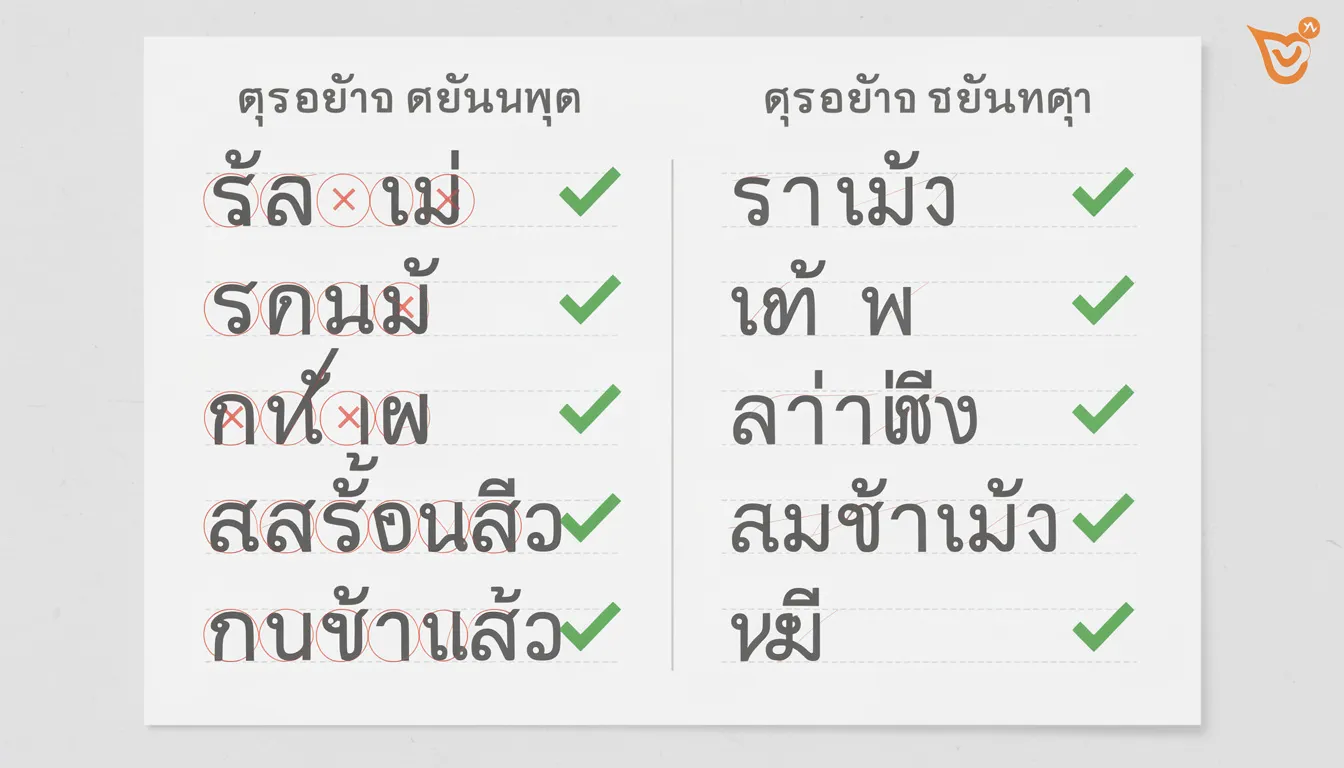
Critical errors to prevent:
-
Mixing print and cursive styles within the same thai text
-
Rushing through practice without checking stroke order
-
Ignoring the combination of the class of consonants and tone rules
-
Writing duplicate consonants where only one belongs
-
Misaligning tone marks with their target letters
Avoiding these mistakes from the beginning prevents developing bad habits that become difficult to correct later. Focus on accuracy over speed during initial learning phases.
Many students struggle with the distinction between such sounds as similar consonants that have the same pronunciation in modern thai. Some Thai consonants are pronounced identically, even though they are written differently. Each Thai consonant is associated with a word that begins with the same sound, which helps learners remember the correct pronunciation. Understanding that these duplicate consonants serve different functions in pali words and native thai words helps explain their continued presence in the writing system.
Daily Practice Routine for Thai Writing
Week 1-2: Practice 10 basic consonants daily with 30 repetitions each, maintaining strict focus on stroke order and formation. Begin with middle class consonants since they appear most frequently in common thai word combinations. Thai consonants are systematically divided into three groups, which influence pronunciation and tone rules.
Week 3-4: Add vowel combinations with practiced consonants, progressing to complete syllable formation. Focus on proper spacing and alignment between consonant and vowel elements in both open syllable and closed syllables configurations.
Week 5-6: Introduce tone marks and practice complete syllables with all five thai tones. Understanding tone rules for each class of consonants becomes crucial during this phase for producing accurate tonal representations.
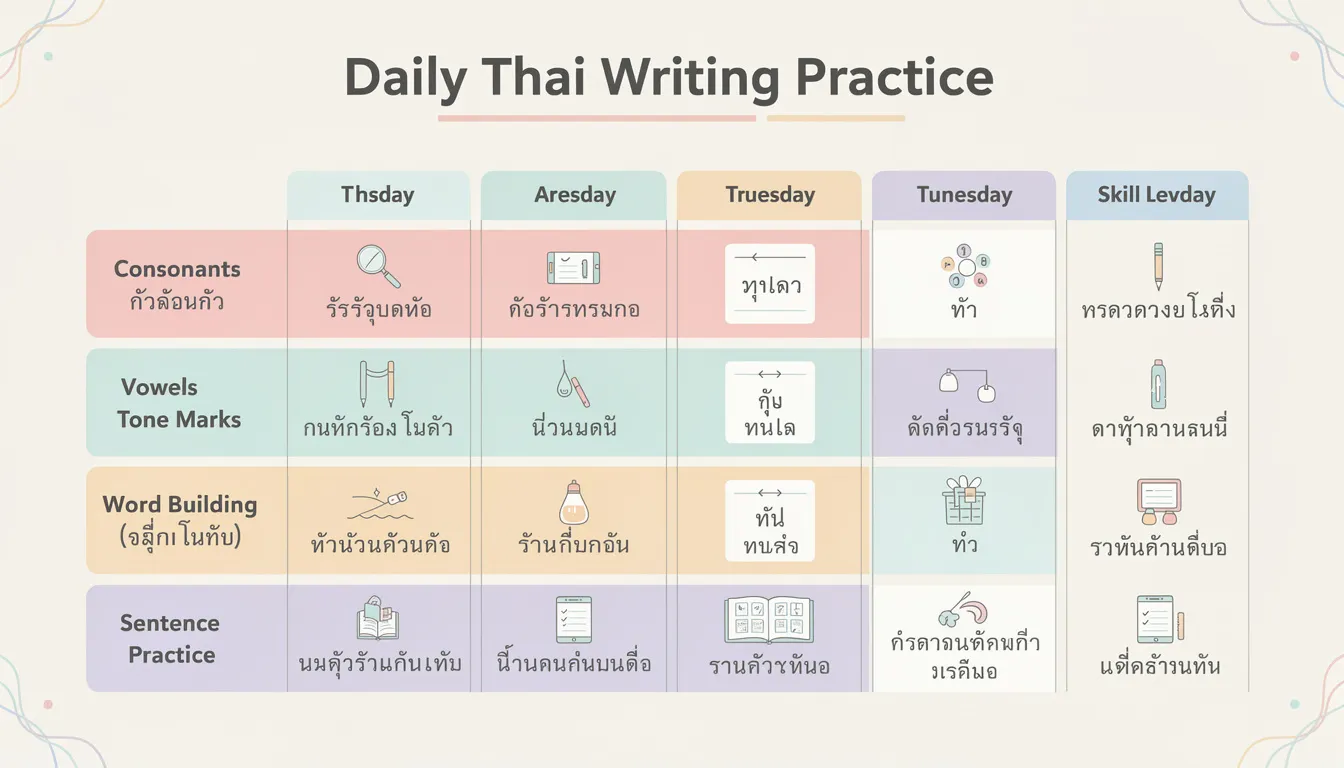
Week 7-8: Write simple thai words and short phrases from vocabulary lists, emphasizing real-world application of learned techniques. Progress to copying text from thai language materials to develop reading and writing coordination. Practicing with pali text can also help learners become familiar with the script's use in religious and historical contexts.
Optimal practice structure:
-
Set consistent daily 20-minute writing sessions
-
Focus on quality over quantity in each session
-
Maintain a thai writing journal for progress tracking
-
Practice related languages’ scripts for context if relevant
-
Review previous weeks’ material regularly to maintain skills
Consistency produces better results than long irregular practice sessions. Daily exposure to thai script helps develop the visual recognition patterns essential for fluent reading and writing.
Many words in thai contain silent letters or final position consonants that don’t affect pronunciation but remain important for proper spelling. Include these elements in regular practice to develop complete writing competency.
Keep a thai writing journal recording new words learned and practiced. Document challenging combinations and return to them regularly until they become automatic. Track progress through weekly assessments of writing speed and accuracy.
The relationship between the english language and thai creates both opportunities and challenges for english speakers learning to write thai. Leverage familiar concepts while remaining alert to fundamental differences in letter formation and spatial organization.
Understanding that thai belongs to the indic alphabets family helps explain certain structural features that differ from european writing systems. This historical context provides framework for understanding why certain rules exist and how they contribute to the overall coherence of thai script.
Regular practice with authentic thai text exposes learners to the natural rhythm and spacing patterns used by native thai speakers. Reading thai text while practicing writing develops integrated language skills that support overall thai language acquisition.
The thai script’s remarkable stability across eight centuries means that mastering these fundamental techniques connects modern learners with the same writing system used throughout thai literary history. This continuity makes every practice session a step toward joining an ancient and continuing tradition of thai written communication.